sexta-feira, 20 de janeiro de 2012

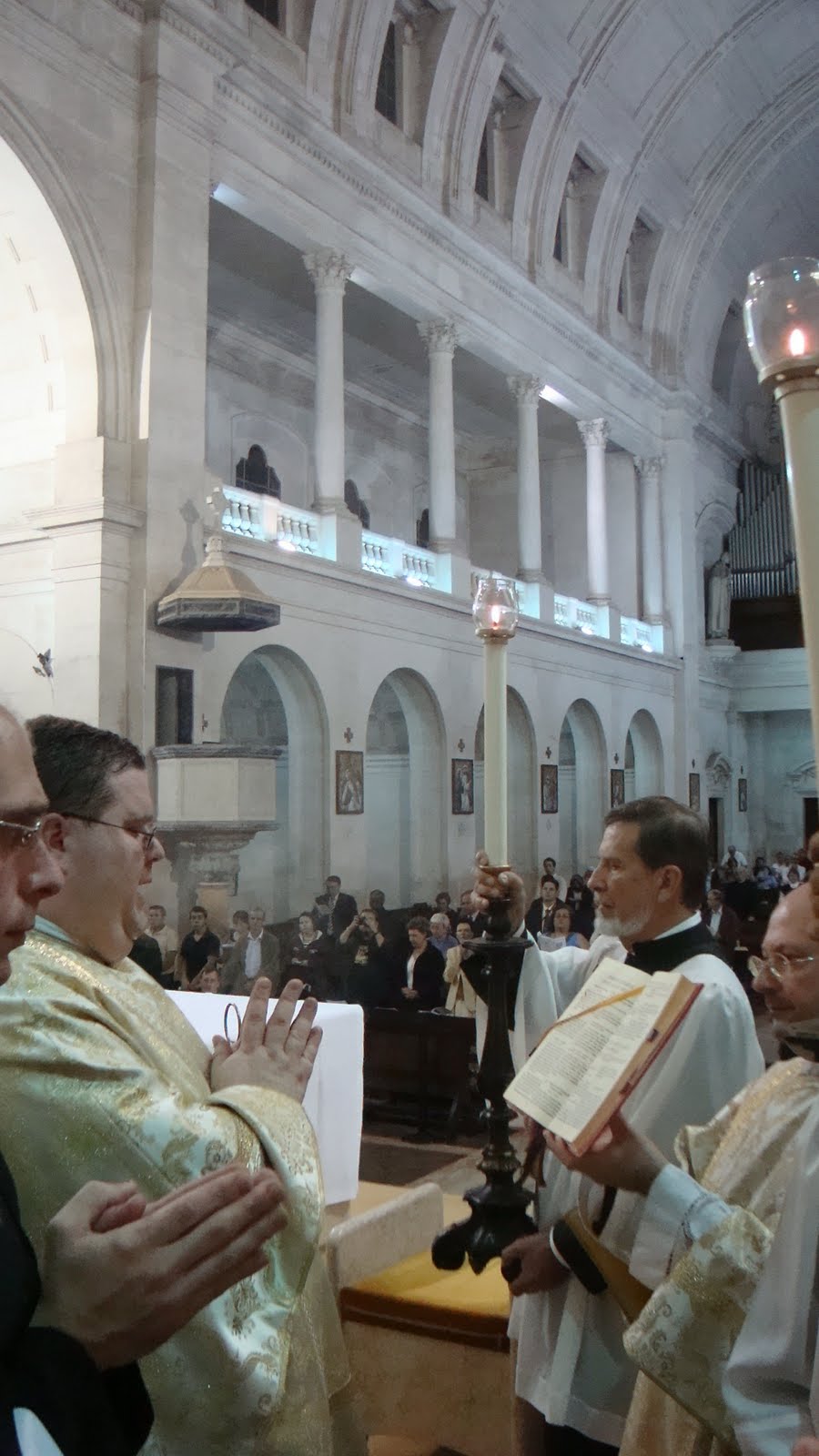
Históricas fotos que testemunham a Missa Solene Gregoriana que no dia 10 de Setembro de 2010 foi celebrada na Basílica de Nª Sª do Rosário de Fátima onde há mais de 40 anos que não se celebrava...Difusão da Missa Gregoriana no mundo


  Foi a Missa dos nossos Santos, a Missa em que participaram os Beatos Francisco e Jacinta Marto ali sepultados na Basílica. Foi grande o momento que se viveu, numa assembleia de Fiéis que superou a centena e no meio dos quais se via vários sacerdotes que se reconheciam pela Batina ou colar romano que usavam , numa palavra era Portugal ali aos pés de Nª Sª de Fátima na obediência às directrizes do Papa Bento XVI. Foi um momento muito alto em que se viveu a Sacralidade do Sacríficio da Santa Missa e podemos contemplar como Deus ama a Beleza no culto que lhe devemos prestar.

 Fonte

Three Items of Note From Portugal: Solemn Mass in the Fatima Basilica; Opening of Fatima Liturgical Conference; Celebration of Rite of Braga


There are a few noteworthy items to report from the Canons Regular of St. John Cantius in Portugal.

The first is that they will be celebrating a Solemn Mass in the usus antiquior in the Basilica of Our Lady of Fatima at 8:00pm (Fatima time) tonight. Those who are in Fatima region may wish to spread the word.

The second is that, Wednesday, they opened their liturgical conference at the “Opus Sanctorum Angelorem” chapel at the Monastery of the Holy Cross in Fatima. Fr. Frank Phillips celebrated a solemn Mass.


The final point of note is that yesterday, Mass was offered according to the Bragan rite/use, which we have spoken about here on the NLM numerous times before.


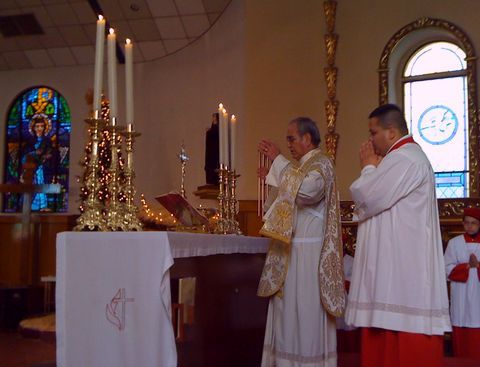
The Preparation of the Chalice at the Beginning of Mass


Prayers at the Foot of the Altar


Images courtesy of Scott Smith Photography


 Mass in the usus antiquiorat Roman Basilica of Opus Dei


In early December, Messa in Latino reported that a regular Mass in the usus antiquior has been scheduled at the Roman Basilica of Sant’Eugenio - built by Ven. Pius XII in honour of his Patron Saint - which is run by Opus Dei. The first Sunday Mass was celebrated on the first Sunday of Advent with the participation of the parish priest and many faithful of the parish.

Mass in Rapallo, Genoa


The Italian site, Maranatha.it has just published some beautiful photographs of Mass celebrated in the usus antiquior this past July 25th by Fr. Federico Icardi in a old oratory located in Rapallo, Genoa (Italian Riviera, North Italy).

I am sure many will also be interested in the architecture.


EF Pontifical Mass in the Czech Republic


Last Saturday, Lourdes was not the only place where a Pontifical Mass in the usus antiquior was celebrated (cf. NLM report here). As we learn by way of the Polish site inspoired by the NLM Nowy Ruch Liturgiczny, the Bishop of Litoměřice (Leitmeritz) in Northern Bohemia, Most Rev. Jan Baxant, on the same day celebrated a Pontifical Mass in the usus antiquior in the parish church of Počaply (Potschapl) which is about 5 km from his See city. The Mass was in honour of St. Adalbert of Prague, to whom the beautiful church (built in its current form by the famous Kilian Ignaz Dientzenhofer) is dedicated and a relic of whom was venerated on the occasion. The website of the Czech and Slovak Association of Juventutem has posted a photo gallery, of which here are some samples:


Vespers (Usus Antiquior) from St. Stephen's Basilica, Budapest


With the celebration of Vespers this evening in Budapest, in the beautiful Basilica of St. Stephen, the Budapest liturgical conference hosted by the St. Augustine Liturgical Atelier was officially commenced.

Here are a few images of the Cathedral-Basilica itself, which is quite impressive and boasts the relic of the right hand of St. Stephen.


The Vespers themselves were celebrated at the throne by Cardinal Laszlo Paskai, the former Archbishop of Esztergom with the Apostolic Nuncio of Hungary in attendance. He wore a magnificant cope for the occasion. The schola was that of the Basilica itself, which sung both chant and polyphony to great acclaim. They were indeed quite excellent.

For those who have not experienced the opportunity to participate in chanted Vespers from the 1962 Breviarium Romanum, I must encourage you to do so. No matter how often I do it, I always come away from it enriched and uplifted.

Here are a few images from the Vespers service itself:


Usus Antiquior: Georgetown University


A few NLM readers sent me in notes about the re-emergence of the Solemn form of the usus antiquior at Georgetown University in Washington, DC. yesterday evening.

The celebrant was Fr. Stephen M. Fields, S.J.; the deacon, Msgr. Charles E. Pope; and the subdeacon, Fr. John R. Siberski, S.J. It is reported to me that a umber of the servers were Georgetown students.

The Mass had a Gregorian schola of seven men, the Canticum Novum Schola, and was celebrated in the Copley Crypt Chapel at Georgetown University.

The NLM is also told that the celebrant, Fr. Fields, said it was probably the first traditional High Mass on campus in 44 years. (Low Masses are said Wednesdays and Sundays.)


Usus Antiquior in Latin America


It is often said that the Extraordinary Form is primarily of interest to Europe and North America. While it is certainly to be hoped that the restoration of the sacred, of which the diffusion of the usus antiquior is a very important part, becomes more wide-spread outside these areas, it is simply not true that there is no interest in other parts of the world.

As an example, here are some images of recent Masses in the Extraordinary Form in Latin America (taken from the excellent site of Una Voce Málaga):

Parish of Mary Mother of the Church, La Florida, Santiago de Chile, Chile:


Parish of St. Stephen, Puente Alto, Santiago de Chile, Chile:


Parish of St. Thérèse, Guayaquil, Ecuador:


Chapel of the Holy Face, Mar del Plata, Argentina:


Parish of St. John the Baptist of Tauape, Fortaleza, Brazil:


Chapel of St. Peter the Apsotle, Guadalajara, Mexico:


Parish of St. Roch, Buenos Aires, Argentina:


First Pontifical Mass at Elysburg Carmel


A reader sent in news and pictures about the the first Pontifical Mass offered at the Carmel of Jesus, Mary and Joseph in Elysburg, PA since its founding in 2009. We have mentioned this monastery before (cf here and here). Here is what he writes:


Bishop William Waltersheid, the celebrant of the Mass, was at that time the Vicar for Clergy and Religious in the Diocese of Harrisburg and played an instrumental role in bringing the sisters to Elysburg, where a Carmelite monastery stood empty after it was closed a few years earlier due to lack of vocations. Recently appointed Auxiliary Bishop of Pittsburg, he returned to celebrate his first Pontifical Mass for their patronal feast of Our Lady of Mt. Carmel. Living the traditional Carmelite rule and praying the traditional Mass and Office, the sisters have continued to flourish in their new house, attracting many young vocations from around the country. His Excellency Bishop Joseph McFadden, Bishop of the Diocese of Harrisburg in which the Carmel is located, assisted at the Mass from the Throne. Many Diocesan Priests and seminarians came to fulfill the roles of Sacred Ministers and servers for the Mass.


Usus Antiquior at Harvard University


As readers will know, we here at the NLM are always eager to promote and report on Masses in either the usus antiquior or in a "reform of the reform" vein which are taking place at university campuses and amongst university students. Accordingly, we were delighted to hear of the following Mass which took place at the prestigious American ivy league school, Harvard University, in Cambridge, MA.:

The Harvard Latin Mass Society have sent us some photos of the Mass.


Sung Mass in Virginia Showcases Beautiful Gothic Revival Commissioned Vestments


One of our readers sent in photos from a recent Sung Mass (usus antiquior) at St. Mary's in Alexandria, Virginia, on the occasion of the Feast of the Assumption.

I particularly wanted to bring your attention to it because of the excellent vestments, which goes along with the recent NLM post about a revival in the liturgical arts. The vestments were designed by Gardiner Hall Inc. and include an antique French embroidery of the BVM, embroidered fleur de lys on Fairford damask orphreys, and a base fabric of Watts Crevelli Brocatelle. The tailoring and orphrey embroidery were done by Hayes and Finch, Liverpool and the set was custom sized for the celebrant, Rev. John De Celle.

Beautiful work, and again, one of the model forms of edifying gothic revival vestments for priests to consider when they are seeking out, or better, commissioning vestments.


The First Mass for Artists, Church of Our Saviour, NYC


We mentioned here a few days back and one other time before that the Mass for Catholic Artists which was being held at Fr. George Rutler's Parish of Christ the Saviour in New York City.

The Society of St. Hugh of Cluny has published a post on the event and give this summation:

... the Catholic Artists Society sponsored its first Solemn High Mass for Artists at Our Saviour’s Church on Park Avenue in New York. A capacity congregation, very proficient in singing the responses, filled the church. But that seems to be the rule for Solemn Masses at this parish. David Hughes led the schola of St. Mary’s Norwalk and Herve Duteil was the organist – need we say that the music was splendid? (Missa super Credidi Propter by Orlando di Lasso and works by Palestrina, Philips, Vaughan Williams, Bach and Messiaen)

[...]

As already noted, there always seems to be a full house for a Solemn mass at Our Saviour’s. But the Catholic Artists Society has succeeded in bringing most of them down to the lecture hall as well. It was heartening to see so many artists – and would-be artists – especially given the nonexistent Catholic presence in the arts in New York. Perhaps these artists have only been waiting for something like the Catholic Artists Society to come along to draw them all out of the woodwork. In any case, we will be hearing more from this Society in the near future…..

A few photos of the Mass and the conference.


Photos from Mass at the High Altar of York Minster


A couple of weeks back, we mentioned a Mass to be celebrated in the usus antiquior at the High Altar of York Minster in York in the North of England.

The NLM is told that all of the music for the Mass (a Missa Cantata) were compositions of William Byrd, the great English composer, excepting of course for the propers. The Rudgate Singers sang the Mass for Five Voices, Justorum Animae (Offertory motet), Ave Verum Corpus (Communion motet), and Ave Regina Caelorum.

The Celebrant of the Mass was Fr Stephen Maughan from English Marty's Church, Dalton Terrace, York.

Approximately 800 people were said to be in attendance.

Following the Mass there was a procession through the medieval heart of York to one of the oldest streets called the Shambles where there is the Shrine of St Margaret Clitherow. The procession then continued through the city to Ouse Bridge (over the River Ouse) which was the place of her martyrdom. From there it continued to English Martyr's Church for Benediction and Veneration of the relic of St Margaret Clitherow.

The Mass was coordinated by the Latin Mass Society of England and Wales.

Dr John Ridgeway-Wood was kind enough to send us some pictures from the Mass which we are only too pleased to publish -- see his full photo set.


(The Canon Chancellor and Precentor of York Minster in attendance)


First Mass of New FSSP Priests


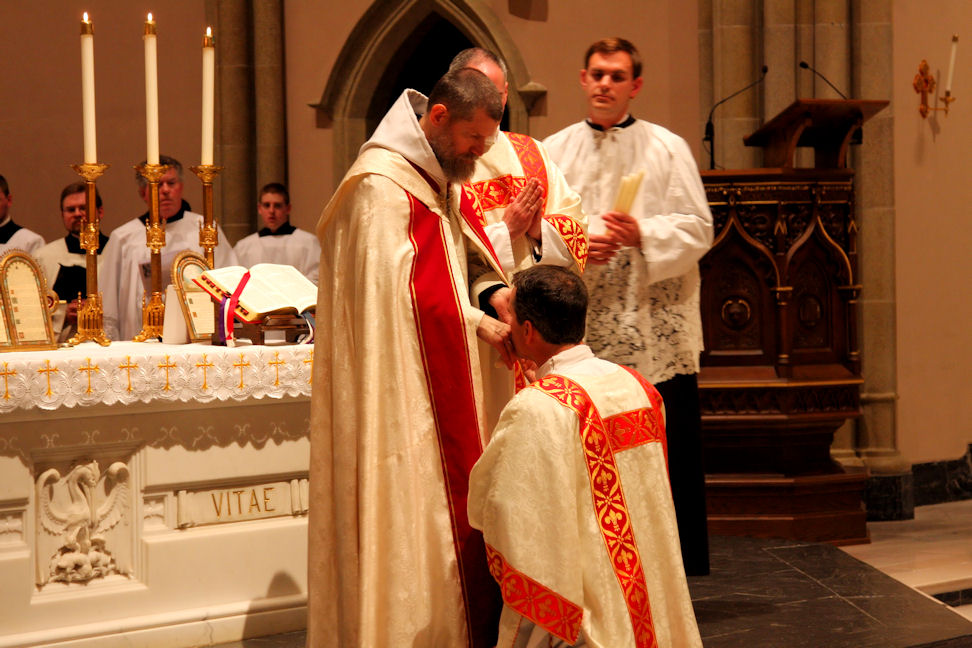
Today I was blessed to attend here in Berlin the First Mass (in German Primiz; you can read about that term and customs surrounding it in the posts about our Holy Father's First Mass which I wrote a while ago here and here) of two of the new priests who were ordained for the Priestly Fraternity of St. Peter on 3 July in Wigratzbad by His Eminence Antonio Cardinal Cañizares Llovera (cf. here). The Mass was celebrated as a Solemn High Mass by Fr Jérôme Bücker FSSP, the other newly ordained, Fr Gerald Gesch, acting as deacon, and Fr Sven Conrad FSSP as subdeacon. Both new priests hail from the parish of St. Matthias in Berlin, where Blessed Count Clement Augustus Cardinal Galen was parish priest from 1919 to 1929. This parish has always been known for a dignified celebration of the liturgy, and has an Ordinary Form Latin Sung Mass every second Sunday. The parish priest had traveled to Wigratzbad for the ordination, acted as presbyter assistens for today's High Mass, and also gave the sermon (in which he mentioned that what most struck him at the ordination at Wigratzbad was the exalted prince of the Church kissing the newly ordaineds' hands, a custom he did not recall from his own ordination, even though that was still according to the usus antiquior books). The Mass replaced the regular 11 am Sunday High Mass, and a good number of faithful filling the church belonged to the parish without having prior familiarity with the usus antiquior, as was evidenced when they sung the entire Pater noster, as is the norm in the Ordinary Form. It was a wonderful occasion, and a very good sign of unity, as well as for the Extraordinary Form taking its rightful place at the centre of the Church, fruitfully co-existing with the Ordinary Form. Another son of the parish celebrated his First Mass in the Ordinary Form there last year, another will be ordained transitional deacon next year, and yet another is a seminarian with the Servi Jesu et Mariæ. Congratulations again to the newly ordained, and to the parish!

Since I did not want to take pictures during Mass, here are some from the German site http://www.summorum-pontificum.de/:


Dom Cassian Folsom, OSB, Offers Solemn Mass at Cathedral of St. John Berchmans


We mentioned earlier last month that the Cathedral of St. John Berchmans in the Diocese of Shreveport was hosting a liturgical conference from January 31st to Feburary 3rd for priests in that region, In Utroque Usu: The Pursuit of the Two Forms of the Roman Liturgy.

The conference was to include a number of interesting and highly relevant topics for a new liturgical movement, including mutual enrichment, the hermeneutic of continuity, the reform of the reform, and noble simplicity.

As was also noted, Msgr. Andrew Wadsworth, the Executive Director of ICEL, was slated as the keynote speaker for this conference, and Dom Cassian Folsom, OSB, Prior of the Monastery of Norcia (Italy) was the celebrant of a Solemn Mass.

While -- as of yet -- we have no reports on the conference proper, we have received some photographs of the aforementioned Solemn Mass offered by Dom Cassian Folsom, OSB.


http://www.newliturgicalmovement.org/

segunda-feira, 2 de janeiro de 2012

Apostolic Letter "Summorum Pontificum" issued Motu Proprio Benedict XVI


Apostolic Letter "Summorum Pontificum" issued Motu Proprio Benedict XVI


This letter of Pope Benedict XVI was issued 7 July 2007 together with his Apostolic Letter "Summorum Pontificum" on the celebration of the Roman Rite according to the Missal of 1962. The following is the Vatican's unofficial translation of the official Latin text.
My dear Brother Bishops,

With great trust and hope, I am consigning to you as Pastors the text of a new Apostolic Letter "Motu Proprio data" on the use of the Roman liturgy prior to the reform of 1970. The document is the fruit of much reflection, numerous consultations and prayer.

News reports and judgments made without sufficient information have created no little confusion. There have been very divergent reactions ranging from joyful acceptance to harsh opposition, about a plan whose contents were in reality unknown.

This document was most directly opposed on account of two fears, which I would like to address somewhat more closely in this letter.

In the first place, there is the fear that the document detracts from the authority of the Second Vatican Council, one of whose essential decisions – the liturgical reform – is being called into question. This fear is unfounded. In this regard, it must first be said that the Missal published by Paul VI and then republished in two subsequent editions by John Paul II, obviously is and continues to be the normal Form – the Forma ordinaria – of the Eucharistic Liturgy. The last version of the Missale Romanum prior to the Council, which was published with the authority of Pope John XXIII in 1962 and used during the Council, will now be able to be used as a Forma extraordinaria of the liturgical celebration. It is not appropriate to speak of these two versions of the Roman Missal as if they were "two Rites". Rather, it is a matter of a twofold use of one and the same rite.

As for the use of the 1962 Missal as a Forma extraordinaria of the liturgy of the Mass, I would like to draw attention to the fact that this Missal was never juridically abrogated and, consequently, in principle, was always permitted.read...

On Saturday 7 July 2007 Pope Benedict XVI issued an Apostolic Letter on the celebration of the Roman Rite according to the Missal of 1962. The following text is the unofficial Vatican Information Service translation of the official Latin text.

Up to our own times, it has been the constant concern of supreme pontiffs to ensure that the Church of Christ offers a worthy ritual to the Divine Majesty, 'to the praise and glory of His name,' and 'to the benefit of all His Holy Church.'
Since time immemorial it has been necessary - as it is also for the future - to maintain the principle according to which 'each particular Church must concur with the universal Church, not only as regards the doctrine of the faith and the sacramental signs, but also as regards the usages universally accepted by uninterrupted apostolic tradition, which must be observed not only to avoid errors but also to transmit the integrity of the faith, because the Church's law of prayer corresponds to her law of faith.' (1)
Among the pontiffs who showed that requisite concern, particularly outstanding is the name of St. Gregory the Great, who made every effort to ensure that the new peoples of Europe received both the Catholic faith and the treasures of worship and culture that had been accumulated by the Romans in preceding centuries. He commanded that the form of the sacred liturgy as celebrated in Rome (concerning both the Sacrifice of Mass and the Divine Office) be conserved. He took great concern to ensure the dissemination of monks and nuns who, following the Rule of St. Benedict, together with the announcement of the Gospel illustrated with their lives the wise provision of their Rule that 'nothing should be placed before the work of God.' In this way the sacred liturgy, celebrated according to the Roman use, enriched not only the faith and piety but also the culture of many peoples. It is known, in fact, that the Latin liturgy of the Church in its various forms, in each century of the Christian era, has been a spur to the spiritual life of many saints, has reinforced many peoples in the virtue of religion and fecundated their piety.
Many other Roman pontiffs, in the course of the centuries, showed particular solicitude in ensuring that the sacred liturgy accomplished this task more effectively. Outstanding among them is St. Pius V who, sustained by great pastoral zeal and following the exhortations of the Council of Trent, renewed the entire liturgy of the Church, oversaw the publication of liturgical books amended and 'renewed in accordance with the norms of the Fathers,' and provided them for the use of the Latin Church.
One of the liturgical books of the Roman rite is the Roman Missal, which developed in the city of Rome and, with the passing of the centuries, little by little took forms very similar to that it has had in recent times.
"It was towards this same goal that succeeding Roman Pontiffs directed their energies during the subsequent centuries in order to ensure that the rites and liturgical books were brought up to date and when necessary clarified. From the beginning of this century they undertook a more general reform.' (2) Thus our predecessors Clement VIII, Urban VIII, St. Pius X (3), Benedict XV, Pius XII and Blessed John XXIII all played a part.
In more recent times, Vatican Council II expressed a desire that the respectful reverence due to divine worship should be renewed and adapted to the needs of our time. Moved by this desire our predecessor, the Supreme Pontiff Paul VI, approved, in 1970, reformed and partly renewed liturgical books for the Latin Church. These, translated into the various languages of the world, were willingly accepted by bishops, priests and faithful. John Paul II amended the third typical edition of the Roman Missal. Thus Roman pontiffs have operated to ensure that 'this kind of liturgical edifice ... should again appear resplendent for its dignity and harmony.' (4)
But in some regions, no small numbers of faithful adhered and continue to adhere with great love and affection to the earlier liturgical forms. These had so deeply marked their culture and their spirit that in 1984 the Supreme Pontiff John Paul II, moved by a concern for the pastoral care of these faithful, with the special indult 'Quattuor abhinc anno," issued by the Congregation for Divine Worship, granted permission to use the Roman Missal published by Blessed John XXIII in the year 1962.read...

BRIEF DES HEILIGEN VATERS PAPST BENEDIKT XVI. AN DIE BISC ÜBER DIE RÖMISCHE LITURGIE IN IHRER GESTALT VOR DER 1970 DURCHGEFÜHRTEN REFORM


Liebe Brüder im Bischofsamt,
hoffnungsvoll und mit großem Vertrauen lege ich den Text eines neuen als Motu Proprio erlassenen Apostolischen Schreibens über den Gebrauch der römischen Liturgie in ihrer Gestalt vor der 1970 durchgeführten Reform in Eure Hände, die Hände der Hirten. Das Dokument ist Frucht langen Nachdenkens, vielfacher Beratungen und des Gebetes.
Nachrichten und Beurteilungen, die ohne ausreichende Kenntnis vorgenommen wurden, haben in nicht geringem Maße Verwirrung gestiftet. Es gibt sehr unterschiedliche Reaktionen, die von freudiger Aufnahme bis zu harter Opposition reichen und die sich auf ein Vorhaben beziehen, dessen Inhalt in Wirklichkeit nicht bekannt war.
Dem Dokument standen näherhin zwei Befürchtungen entgegen, auf die ich in diesem Brief etwas näher eingehen möchte.
An erster Stelle steht die Furcht, hier werde die Autorität des II. Vatikanischen Konzils angetastet und eine seiner wesentlichen Entscheidungen – die liturgische Reform – in Frage gestellt. Diese Befürchtung ist unbegründet. Dazu ist zunächst zu sagen, daß selbstverständlich das von Papst Paul VI. veröffentlichte und dann in zwei weiteren Auflagen von Johannes Paul II. neu herausgegebene Missale die normale Form – die Forma ordinaria – der Liturgie der heiligen Eucharistie ist und bleibt. Die letzte dem Konzil vorausgehende Fassung des Missale Romanum, die unter der Autorität von Papst Johannes XXIII. 1962 veröffentlicht und während des Konzils benützt wurde, kann demgegenüber als Forma extraordinaria der liturgischen Feier Verwendung finden. Es ist nicht angebracht, von diesen beiden Fassungen des Römischen Meßbuchs als von „zwei Riten“ zu sprechen. Es handelt sich vielmehr um einen zweifachen Usus ein und desselben Ritus.
Was nun die Verwendung des Meßbuchs von 1962 als Forma extraordinaria der Meßliturgie angeht, so möchte ich darauf aufmerksam machen, daß dieses Missale nie rechtlich abrogiert wurde und insofern im Prinzip immer zugelassen blieb.lesen...
Papst Benedikt XVI.: Das Apostolisches Schreiben an die Bischöfe der Welt als Motu Proprio: SUMMO- RUM PONTIFICUM Über den Gebrauch der Römischen Liturgie aus der Zeit vor der Reform von 1970
   Die Sorge der Päpste ist es bis zur heutigen Zeit stets gewesen, dass die Kirche Christi der Göttlichen Majestät einen würdigen Kult darbringt, „zum Lob und Ruhm Seines Namens” und „zum Segen für Seine ganze heilige Kirche”.
   Seit unvordenklicher Zeit wie auch in Zukunft gilt es den Grundsatz zu wahren, „demzufolge jede Teil- kirche mit der Gesamtkirche nicht nur hinsichtlich der Glaubenslehre und der sakramentalen Zeichen übereinstimmen muss, sondern auch hinsichtlich der universal von der apostolischen und ununter- brochenen Überlieferung empfangenen Gebräuche, die einzuhalten sind, nicht nur um Irrtümer zu ver- meiden, sondern auch damit der Glaube unversehrt weitergegeben wird; denn das Gesetz des Betens lex orandi der Kirche entspricht ihrem Gesetz des Glaubens lex credendi."
   Unter den Päpsten, die eine solche gebotene Sorge walten ließen, ragt der Name des heiligen Gregor des Großen heraus; dieser sorgte dafür, dass sowohl der katholische Glaube als auch die Schätze des Kultes und der Kultur, welche die Römer der vorangegangenen Jahrhunderte angesammelt hatten, den jungen Völkern Europas übermittelt wurden. Er ordnete an, dass die in Rom gefeierte Form der heiligen Liturgie – sowohl des Messopfers als auch des Breviergebetes Officium Divinum – festgestellt und bewahrt werde. Eine außerordentlich große Stütze war sie den Mönchen und auch den Nonnen, die unter der Regel des heiligen Benedikt dienten und überall zugleich mit der Verkündigung des Evangeliums durch ihr Leben auch jenen äußerst heilsamen Satz veranschaulichten, dass „dem Gottesdienst nichts vorzuziehen” sei Kap. 43. Auf solche Weise befruchtete die heilige Liturgie nach römischem Brauch nicht nur den Glauben und die Fröm- migkeit, sondern auch die Kultur vieler Völker. Es steht fraglos fest, dass die lateinische Liturgie der Kirche – mit ihren verschiedenen Formen in allen Jahrhun- derten der christlichen Zeit – sehr viele Heilige im geistlichen Leben angespornt und so viele Völker in der Tugend der Gottesverehrung gestärkt und deren Frömmigkeit befruchtet hat.
   Dass aber die heilige Liturgie diese Aufgabe noch wirksamer erfüllte, darauf haben verschiedene weitere Päpste im Verlauf der Jahrhunderte besondere Sorgfalt verwandt; unter ihnen ragt der heilige Pius V. heraus, der mit großem seelsorglichen Eifer auf Veranlassung des Konzils von Trient den ganzen Kult der Kirche erneuerte, die Herausgabe verbesserter und „nach der Norm der Väter reformierter” liturgischer Bücher besorgte und sie der lateinischen Kirche zum Gebrauch übergab.
   Unter den liturgischen Büchern des römischen Ritus ragt das Römische Messbuch deutlich heraus; es ist in der Stadt Rom entstanden und hat in den nachfolgenden Jahrhunderten schrittweise Formen angenommen, die große Ähnlichkeit haben mit der in den letzten Generationen geltenden.
„Dasselbe Ziel verfolgten die Päpste im Lauf der folgenden Jahrhunderte, indem sie sich um die Erneuerung oder die Festlegung der liturgischen Riten und Bücher bemühten und schließlich am Beginn dieses Jahrhunderts eine allgemeine Reform in Angriff nahmen”. So aber hielten es Unsere Vorgänger Clemens VIII., Urban VIII., der heilige Pius X., Benedikt XV., Pius XII. und der selige Johannes XXIII.lesen...

LETTRE DU PAPE BENOÎT XVI AUX ÉVÊQUES QUI ACCOMPAGNE LA LETTRE APOSTOLIQUE "MOTU PROPRIO DATA" SUMMORUM PONTIFICUM SUR L'USAGE DE LA LITURGIE ROMAINE ANTÉRIEURE À LA RÉFORME DE 1970

ent


  Chers frères dans l’Episcopat,
C’est avec beaucoup de confiance et d’espérance que je remets entre vos mains de Pasteurs le texte d’une nouvelle Lettre Apostolique « Motu Proprio data », sur l’usage de la liturgie romaine antérieure à la réforme de 1970. Ce document est le fruit de longues réflexions, de multiples consultations, et de la prière.
Des nouvelles et des jugements formulés sans information suffisante, ont suscité beaucoup de confusion. On trouve des réactions très diverses les unes des autres, qui vont de l’acceptation joyeuse à une dure opposition, à propos d’un projet dont le contenu n’était, en réalité, pas connu.
Deux craintes s’opposaient plus directement à ce document, et je voudrais les examiner d’un peu plus près dans cette lettre.
En premier lieu il y a la crainte d’amenuiser ainsi l’Autorité du Concile Vatican II, et de voir mettre en doute une de ses décisions essentielles – la réforme liturgique.
Cette crainte n’est pas fondée. A ce propos, il faut dire avant tout que le Missel, publié par Paul VI et réédité ensuite à deux reprises par Jean-Paul II, est et demeure évidemment la Forme normale – la Forma ordinaria – de la liturgie Eucharistique. La dernière version du Missale Romanum, antérieure au Concile, qui a été publiée sous l’autorité du Pape Jean XXIII en 1962 et qui a été utilisée durant le Concile, pourra en revanche être utilisée comme Forma extraordinaria de la Célébration liturgique. Il n’est pas convenable de parler de ces deux versions du Missel Romain comme s’il s’agissait de « deux Rites ». Il s’agit plutôt d’un double usage de l’unique et même Rite.
Quant à l’usage du Missel de 1962, comme Forma extraordinaria de la Liturgie de la Messe, je voudrais attirer l’attention sur le fait que ce Missel n’a jamais été juridiquement abrogé, et que par conséquent, en principe, il est toujours resté autorisé.LIRE.
LETTRE APOSTOLIQUE
EN FORME DE MOTU PROPRIO
«Motu Proprio data» Summorum Pontificum
DU SOUVERAIN PONTIFE
BENOÎT XVI
Sur l’usage de la Liturgie romaine antérieure à la réforme de 1970


LES SOUVERAINS PONTIFES ont toujours veillé jusqu’à nos jours à ce que l’Église du Christ offre à la divine Majesté un culte digne, « à la louange et à la gloire de son nom » et « pour le bien de toute sa sainte Église ».

Depuis des temps immémoriaux et aussi à l’avenir, le principe à observer est que «chaque Église particulière doit être en accord avec l’Église universelle, non seulement quant à la doctrine de la foi et aux signes sacramentels, mais aussi quant aux usages reçus universellement de la tradition apostolique ininterrompue, qui sont à observer non seulement pour éviter des erreurs, mais pour transmettre l’intégrité de la foi, parce que la lex orandi de l’Église correspond à sa lex credendi » (1) .
.

Parmi les Pontifes qui ont eu ce soin se distingue le nom de saint Grégoire le Grand qui fut attentif à transmettre aux nouveaux peuples de l’Europe tant la foi catholique que les trésors du culte et de la culture accumulés par les Romains au cours des siècles précédents. Il ordonna de déterminer et de conserver la forme de la liturgie sacrée, aussi bien du Sacrifice de la Messe que de l’Office divin, telle qu’elle était célébrée à Rome. Il encouragea vivement les moines et les moniales qui, vivant sous la Règle de saint Benoît, firent partout resplendir par leur vie, en même temps que l’annonce de l’Évangile, cette très salutaire manière de vivre de la Règle, « à ne rien mettre au-dessus de l’œuvre de Dieu» (chap. 43). Ainsi, la liturgie selon les coutumes de Rome féconda non seulement la foi et la piété mais aussi la culture de nombreux peuples. C’est un fait en tout cas que la liturgie latine de l’Église sous ses diverses formes, au cours des siècles de l’ère chrétienne, a été un stimulant pour la vie spirituelle d’innombrables saints et qu’elle a affermi beaucoup de peuples par la religion et fécondé leur piété.

Au cours des siècles, beaucoup d’autres Pontifes romains se sont particulièrement employés à ce que la liturgie accomplisse plus efficacement cette tâche ; parmi eux se distingue saint Pie V, qui, avec un grand zèle pastoral, suivant l’exhortation du Concile de Trente, renouvela tout le culte de l’Église, fit éditer des livres liturgiques corrigés et «réformés selon la volonté des Pères », et les donna à l’Église latine pour son usage.

Parmi les livres liturgiques du Rite romain, la première place revient évidemment au Missel romain, qui se répandit dans la ville de Rome puis, les siècles suivants, prit peu à peu des formes qui ont des similitudes avec la forme en vigueur dans les générations récentes.

C’est le même objectif qu’ont poursuivi les Pontifes romains au cours des siècles suivants en assurant la mise à jour des rites et des livres liturgiques ou en les précisant, et ensuite, depuis le début de ce siècle, en entreprenant une réforme plus générale » (2) . Ainsi firent mes prédécesseurs Clément VIII, Urbain VIII, saint Pie X (3) , Benoît XV et le bienheureux Jean XXIII. LIRE.....

CARTA DEL SANTO PADRE BENEDICTO XVI A LOS OBISPOS QUE ACOMPAÑA LA CARTA APOSTÓLICA "MOTU PROPRIO DATA" SUMMORUM PONTIFICUM SOBRE EL USO DE LA LITURGIA ROMANA ANTERIOR A LA REFORMA EFECTUADA EN 1970


Queridos Hermanos en el Episcopado:
Con gran confianza y esperanza pongo en vuestras manos de Pastores el texto de una nueva Carta Apostólica “Motu Proprio data” sobre el uso de la liturgia romana anterior a la reforma efectuada en 1970. El documento es fruto de largas reflexiones, múltiples consultas y de oración.
Noticias y juicios hechos sin información suficiente han creado no poca confusión. Se han dado reacciones muy divergentes, que van desde una aceptación con alegría a una oposición dura, a un proyecto cuyo contenido en realidad no se conocía.
A este documento se contraponían más directamente dos temores, que quisiera afrontar un poco más de cerca en esta carta.
En primer lugar existe el temor de que se menoscabe la Autoridad del Concilio Vaticano II y de que una de sus decisiones esenciales – la reforma litúrgica – se ponga en duda. Este temor es infundado. Al respecto, es necesario afirmar en primer lugar que el Misal, publicado por Pablo VI y reeditado después en dos ediciones sucesivas por Juan Pablo II, obviamente es y permanece la Forma normal – la Forma ordinaria – de la Liturgia Eucarística. La última redacción del Missale Romanum, anterior al Concilio, que fue publicada con la autoridad del Papa Juan XXIII en 1962 y utilizada durante el Concilio, podrá, en cambio, ser utilizada como Forma extraordinaria de la Celebración litúrgica. Non es apropiado hablar de estas dos redacciones del Misal Romano como si fueran “dos Ritos”. Se trata, más bien, de un doble uso del mismo y único Rito.
Por lo que se refiere al uso del Misal de 1962, como Forma extraordinaria de la Liturgia de la Misa, quisiera llamar la atención sobre el hecho de que este Misal no ha sido nunca jurídicamente abrogado y, por consiguiente, en principio, ha quedado siempre permitido.LEER...

MOTU PROPRIO "SUMMORUM PONTIFICUM" e LETTERA AI VESCOVI DI SUA SANTITÀ PAPA BENEDETTO XVI


 Motu Proprio SUMMORUN PONTIFICUM e LETTERA AI VESCOVI - 7 Luglio 2007


LETTERA APOSTOLICA DI
SUA SANTITÀ BENEDETTO XVI
MOTU PROPRIO DATA

[Latino, Ungherese, Italiano, Inglese]

SUMMORUM PONTIFICUM

I Sommi Pontefici fino ai nostri giorni ebbero costantemente cura che la Chiesa di Cristo offrisse alla Divina Maestà un culto degno, “a lode e gloria del Suo nome” ed “ad utilità di tutta la sua Santa Chiesa”.

Da tempo immemorabile, come anche per l’avvenire, è necessario mantenere il principio secondo il quale “ogni Chiesa particolare deve concordare con la Chiesa universale, non solo quanto alla dottrina della fede e ai segni sacramentali, ma anche quanto agli usi universalmente accettati dalla ininterrotta tradizione apostolica, che devono essere osservati non solo per evitare errori, ma anche per trasmettere l’integrità della fede, perché la legge della preghiera della Chiesa corrisponde alla sua legge di fede”[1]. leggere ...
LETTERA DI SUA SANTITÀ
BENEDETTO XVI
AI VESCOVI IN OCCASIONE DELLA PUBBLICAZIONE
DELLA LETTERA APOSTOLICA "MOTU PROPRIO DATA"
SUMMORUM PONTIFICUM
SULL'USO DELLA LITURGIA ROMANA
ANTERIORE ALLA RIFORMA EFFETTUATA NEL 1970

[Francese, Inglese, Italiano, Portoghese, Spagnolo, Tedesco]


Cari Fratelli nell’Episcopato,

con grande fiducia e speranza metto nelle vostre mani di Pastori il testo di una nuova Lettera Apostolica “Motu Proprio data” sull’uso della liturgia romana anteriore alla riforma effettuata nel 1970. Il documento è frutto di lunghe riflessioni, di molteplici consultazioni e di preghiera.

Notizie e giudizi fatti senza sufficiente informazione hanno creato non poca confusione. Ci sono reazioni molto divergenti tra loro che vanno da un’accettazione gioiosa ad un’opposizione dura, per un progetto il cui contenuto in realtà non era conosciuto.

A questo documento si opponevano più direttamente due timori, che vorrei affrontare un po’ più da vicino in questa lettera.

In primo luogo, c’è il timore che qui venga intaccata l’Autorità del Concilio Vaticano II e che una delle sue decisioni essenziali – la riforma liturgica – venga messa in dubbio. Tale timore è infondato. Al riguardo bisogna innanzitutto dire che il Messale, pubblicato in duplice edizione da Paolo VI e poi riedito una terza volta con l'approvazione di Giovanni Paolo II, ovviamente è e rimane la forma normale – la forma ordinaria – della Liturgia Eucaristica. L’ultima stesura del Missale Romanum, anteriore al Concilio, che è stata pubblicata con l’autorità di Papa Giovanni XXIII nel 1962 e utilizzata durante il Concilio, potrà, invece, essere usata come forma extraordinaria della Celebrazione liturgica. Non è appropriato parlare di queste due stesure del Messale Romano come se fossero “due Riti”. Si tratta, piuttosto, di un uso duplice dell’unico e medesimo Rito. Quanto all’uso del Messale del 1962, come forma extraordinaria della Liturgia della Messa, vorrei attirare l’attenzione sul fatto che questo Messale non fu mai giuridicamente abrogato e, di conseguenza, in linea di principio, restò sempre permesso. Al momento dell’introduzione del nuovo Messale, non è sembrato necessario di emanare norme proprie per l’uso possibile del Messale anteriore. LEGGERE...

CARTA DO SANTO PADRE AOS BISPOS SOBRE O MOTUM PROPRIO e Motu Proprio «Summorum Pontificum» de Bento XVI


CARTA DO SANTO PADRE
BENTO XVI
AOS BISPOS QUE ACOMPANHA O "MOTU PROPRIO"
SUMMORUM PONTIFICUM
SOBRE O USO DA LITURGIA ROMANA
ANTERIOR À REFORMA REALIZADA EM 1970

Amados Irmãos no Episcopado,

Com grande confiança e esperança, coloco nas vossas mãos de Pastores o texto duma nova Carta Apostólica «Motu Proprio data» sobre o uso da liturgia romana anterior à reforma realizada em 1970. O documento é fruto de longas reflexões, múltiplas consultas e de oração.

Notícias e juízos elaborados sem suficiente informação criaram não pouca confusão. Há reacções muito divergentes entre si que vão de uma entusiasta aceitação até uma férrea oposição a respeito de um projecto cujo conteúdo na realidade não era conhecido.

Contrapunham-se de forma mais directa a este documento dois temores, dos quais me quero ocupar um pouco mais detalhadamente nesta carta.

Em primeiro lugar, há o temor de que seja aqui afectada a autoridade do Concílio Vaticano II e que uma das suas decisões essenciais – a reforma litúrgica – seja posta em dúvida. Tal receio não tem fundamento. A este respeito, é preciso antes de mais afirmar que o Missal publicado por Paulo VI, e reeditado em duas sucessivas edições por João Paulo II, obviamente é e permanece a Forma normal – a Forma ordinária – da Liturgia Eucarística.

A última versão do Missale Romanum, anterior ao Concílio, que foi publicada sob a autoridade do Papa João XXIII em 1962 e utilizada durante o Concílio, poderá, por sua vez, ser usada como Forma extraordinária da Celebração Litúrgica. Não é apropriado falar destas duas versões do Missal Romano como se fossem «dois ritos». Trata-se, antes, de um duplo uso do único e mesmo Rito.


Quanto ao uso do Missal de 1962, como Forma extraordinária da Liturgia da Missa, quero chamar a atenção para o facto de que este Missal nunca foi juridicamente ab-rogado e, consequentemente, em princípio sempre continuou permitido. Na altura da introdução do novo Missal, não pareceu necessário emanar normas próprias para um possível uso do Missal anterior.

Supôs-se, provavelmente, que se trataria de poucos casos individuais que seriam resolvidos um a um na sua situação concreta. Bem depressa, porém, se constatou que não poucos continuavam fortemente ligados a este uso do Rito Romano que, desde a infância, se lhes tornara familiar. Isto aconteceu sobretudo em países onde o movimento litúrgico tinha dado a muitas pessoas uma formação litúrgica notável e uma profunda e íntima familiaridade com a Forma anterior da Celebração Litúrgica.

Todos sabemos que, no movimento guiado pelo Arcebispo Lefebvre, a fidelidade ao Missal antigo apareceu como um sinal distintivo externo; mas as razões da divisão, que então nascia, encontravam-se a maior profundidade. Muitas pessoas, que aceitavam claramente o carácter vinculante do Concílio Vaticano II e que eram fiéis ao Papa e aos Bispos, desejavam contudo reaver também a forma, que lhes era cara, da sagrada Liturgia; isto sucedeu antes de mais porque, em muitos lugares, se celebrava não se atendo de maneira fiel às prescrições do novo Missal, antes consideravam-se como que autorizados ou até obrigados à criatividade, o que levou frequentemente a deformações da Liturgia no limite do suportável.

Falo por experiência, porque também eu vivi aquele período com todas as suas expectativas e confusões. E vi como foram profundamente feridas, pelas deformações arbitrárias da Liturgia, pessoas que estavam totalmente radicadas na fé da Igreja ler mais...


Motu Proprio «Summorum Pontificum» de Bento XVI

«Os sumos pontífices até nossos dias se preocuparam constantemente para que a Igreja de Cristo oferecesse à Divina Majestade um culto digno de “louvor e glória de Seu nome” e “do bem de toda sua Santa Igreja”.

«Desde tempo imemoriável, como também para o futuro, é necessário manter o princípio segundo o qual, “cada Igreja particular deve concordar com a Igreja universal, não só quanto à doutrina da fé e aos sinais sacramentais, mas também em respeito aos usos universalmente aceitos da ininterrupta tradição apostólica, que devem ser observados não só para evitar erros, mas também para transmitir a integridade da fé, para que a lei da oração da Igreja corresponda a sua lei de fé”.» (1)

«Entre os pontífices que tiveram essa preocupação ressalta o nome de São Gregório Magno, que fez todo o possível para que aos novos povos da Europa se transmitisse tanto a fé católica como os tesouros do culto e da cultura acumulados pelos romanos nos séculos precedentes. Ordenou que fosse definida e conservada a forma da sagrada Liturgia, relativa tanto ao Sacrifício da Missa como ao Ofício Divino, no modo em que se celebrava na Urbe. Promoveu com a máxima atenção a difusão dos monges e monjas que, agindo segundo a regra de São Bento, sempre junto ao anuncio do Evangelho exemplificaram com sua vida a saudável máxima da Regra: “Nada se antecipe à obra de Deus” (Cap. 43). Dessa forma a Sagrada Liturgia, celebrada segundo o uso romano, enriqueceu não somente a fé e a piedade, mas também a cultura de muitas populações. Consta efetivamente que a liturgia latina da Igreja em suas várias formas, em todos os séculos da era cristã, impulsionou na vida espiritual a numerosos santos e fortaleceu a tantos povos na virtude da religião e fecundou sua piedade”.»ler mais...