


News from Two Alumni Priests in Minnesota
 Last weekend St. John Vianney College Seminary in St. Paul, Minn., was the setting for Holy Mass in the Extraordinary Form of the Roman Rite for the first time since adopting the vernacular shortly after Vatican II. Serving as celebrant was Rev. John Paul Erickson (’02), Director of the Archdiocesan Office of Worship for St. Paul and Minneapolis. More photos from the Mass are available at the New Liturgical Movement website.
 SOURCE
Shrine of the Most Blessed Sacrament in Washington, D.C., opens centennial year with Solemn High Mass
 The Shrine of the Most Blessed Sacrament opened their centennial year celebration with a Solemn High Mass last evening and the singing of Te Deum. The Extraordinary Form holy Mass was well attended.
The liturgy was made possible thanks to Msgr. John Enzler, pastor of the Shrine, parish clergy, Msgr. Charles Pope and a corps of servers.
A short video of the choir and congregation singing the final hymn is available here. Note the beautifully appointed altar with abundant candles.
Latin Mass - Ennis Cathedral
 "For the intentions of the Holy Father Pope Benedict XVI, Holy Mass in the Extraordinary Form (Traditional Latin Mass) will be offered by Msgr Seamus Horgan on Tuesday June 29th at 6pm, the Solemn Feast of Ss Peter and Paul, in the Cathedral of Ss Peter and Paul.
 SOURCE
Archbishop Prendergast Celebrates the Traditional Latin Mass
1
Ottawa Archbishop Terrence Prendergast celebrated Holy Mass in the Extraordinary Form of the Roman Rite in Dublin in conjunction with the 2012 International Eucharistic Congress that has been going on all week in Ireland.
As I never get tired of saying, we are extraordinarily blessed to have Archbishop Prendergast as our local bishop here. A bishop is a sign of unity for his diocese; the bishop is the father of everyone. He fills this role, abounding in God's grace. I have seen him in settings where worship is done by a youth band playing rock music… in settings where people began singing in tongues… in settings where Aboriginal Catholics beat their drums. When we were received into the Catholic Church, he made an effort to learn our Anglican Use liturgy, including the gestures and silent prayers. I jokingly asked him, "Did you have to train so you could manage all those genuflections?"
He told me there are more when he celebrates the Traditional Latin Mass at St. Clement's, one of his parishes.
Over at his blog, he has posted some splendid pictures and his homily. In it he explains the relationship between the two forms of the Mass. I personally hope we in the Ordinariates will have as gracious a view of both forms as Archbishop Prendergast. Here are excerpts of his post, including parts of his homily:
 Several weeks before the International Eucharistic Congress (ICE), I received a letter from the CEO of the ICE, Father Kevin Doran, inviting me in Archbishop Diarmuid Martin's name to preside at a Mass in the Extraordinary Form at St. Kevin's Church, Harrington Street, Dublin.
Father Gerard Deighan, Administrator of St. Kevin's and Chaplain to the those attending the Latin Mass, facilitated arrangements: I was to bring the miters and gloves, etc. and he would arrange for ministers (deacon and subdeacon), an MC who could guide us all in a Pontifical Mass on the Feast of the Apostle St. Barnabas (hence the red vestments) and well-trained servers.
The choir of the Parish sang beautifully and the church itself is very fitting for the Mass in the Extraordinary Form; somewhere around 400+/- were in attendance, and a friendly reception took place in the parish fall after the liturgy. The photographer, John Yung, who was very busy later returning home to Singapore from medical school studies, has just sent me a selection of photos he took, which are interspersed with the text of my homily that day.
 Surely, Barnabas and Paul were agents of change. However, Luke goes to great pains to show that Peter introduced the Gentiles into the Church. In addition, Luke reminds us that James, who represented tradition, agreed with this new focus of evangelisation. In other words, the Holy Spirit was guiding the process of change within continuity, and that it was Peter who kept the Church together, even if at times he vacillated.

This is an important point as we gather to celebrate the Mass in its Extraordinary Form during an International Eucharistic Congress when most of our fellow Catholics—and we ourselves—will celebrate in the Ordinary Form.
For, sometimes many in the Church make the mistake of thinking that the Roman Rite has two different Masses, and it’s a matter of taste, which one a person prefers. But the beautiful, profound truth is that we have only one, holy sacrifice of the Mass in two usages: the ordinary and extraordinary forms. This is perhaps one of the best examples of that most Catholic expression of “both/and” and not “either/or.”

It can be a challenge, though, to explain to people who know little of the Church’s history, how we embrace as Catholic, valid, holy and beautiful, these two different forms of the Eucharist. The differences most often grab our attention. We can overlook the shared, fundamental basis of the sacrament of the Eucharist. Sadly, for some, a particular devotion to one form can result in a reluctance to appreciate the truth, goodness and beauty of the other. Tragically, the preferred form of celebrating the sacrament of the Most Holy Body and Blood of our Lord Jesus Christ can divide Catholics. In our human weakness, we can become competing camps rather than a united Mystical Body of Christ.

In his Apostolic Letter Summorum pontificum, Pope Benedict XVI, eloquently reminded us of the heritage of the Roman Rite for Latin Catholics. He praised Pope Pius V who, “sustained by great pastoral zeal and following the exhortations of the Council of Trent, renewed the entire liturgy of the Church.”
SOURCE
Solemn Blessing of new St Benedict's Chapel and first Mass, Chesapeake, Va
 Fr Nichols celebrates the Extraordinary Form of the Roman Rite of holy Mass at the newly blessed altar of St Benedict's Chapel today in Chesapeake, Virginia.
As I never get tired of saying, we are extraordinarily blessed to have Archbishop Prendergast as our local bishop here. A bishop is a sign of unity for his diocese; the bishop is the father of everyone. He fills this role, abounding in God's grace. I have seen him in settings where worship is done by a youth band playing rock music… in settings where people began singing in tongues… in settings where Aboriginal Catholics beat their drums. When we were received into the Catholic Church, he made an effort to learn our Anglican Use liturgy, including the gestures and silent prayers. I jokingly asked him, "Did you have to train so you could manage all those genuflections?"
He told me there are more when he celebrates the Traditional Latin Mass at St. Clement's, one of his parishes.
Over at his blog, he has posted some splendid pictures and his homily. In it he explains the relationship between the two forms of the Mass. I personally hope we in the Ordinariates will have as gracious a view of both forms as Archbishop Prendergast. Here are excerpts of his post, including parts of his homily:
* * *

Father Gerard Deighan, Administrator of St. Kevin's and Chaplain to the those attending the Latin Mass, facilitated arrangements: I was to bring the miters and gloves, etc. and he would arrange for ministers (deacon and subdeacon), an MC who could guide us all in a Pontifical Mass on the Feast of the Apostle St. Barnabas (hence the red vestments) and well-trained servers.
The choir of the Parish sang beautifully and the church itself is very fitting for the Mass in the Extraordinary Form; somewhere around 400+/- were in attendance, and a friendly reception took place in the parish fall after the liturgy. The photographer, John Yung, who was very busy later returning home to Singapore from medical school studies, has just sent me a selection of photos he took, which are interspersed with the text of my homily that day.
* * *
The Feast of St. Barnabas, Apostle–June 11, 2012
Mass in the Extraordinary Form—during the 50th IEC
St. Kevin’s Church, Dublin, Ireland
“THE EUCHARIST: COMMUNION WITH CHRIST
AND WITH ONE ANOTHER”
[Texts: Acts 11.21–26; 13.1–3; Psalm 18, 5, 2; Matthew 10.16–22]
-snip-

This is an important point as we gather to celebrate the Mass in its Extraordinary Form during an International Eucharistic Congress when most of our fellow Catholics—and we ourselves—will celebrate in the Ordinary Form.
For, sometimes many in the Church make the mistake of thinking that the Roman Rite has two different Masses, and it’s a matter of taste, which one a person prefers. But the beautiful, profound truth is that we have only one, holy sacrifice of the Mass in two usages: the ordinary and extraordinary forms. This is perhaps one of the best examples of that most Catholic expression of “both/and” and not “either/or.”

It can be a challenge, though, to explain to people who know little of the Church’s history, how we embrace as Catholic, valid, holy and beautiful, these two different forms of the Eucharist. The differences most often grab our attention. We can overlook the shared, fundamental basis of the sacrament of the Eucharist. Sadly, for some, a particular devotion to one form can result in a reluctance to appreciate the truth, goodness and beauty of the other. Tragically, the preferred form of celebrating the sacrament of the Most Holy Body and Blood of our Lord Jesus Christ can divide Catholics. In our human weakness, we can become competing camps rather than a united Mystical Body of Christ.

In his Apostolic Letter Summorum pontificum, Pope Benedict XVI, eloquently reminded us of the heritage of the Roman Rite for Latin Catholics. He praised Pope Pius V who, “sustained by great pastoral zeal and following the exhortations of the Council of Trent, renewed the entire liturgy of the Church.”
SOURCE
Solemn Blessing of new St Benedict's Chapel and first Mass, Chesapeake, Va

Mass for the Month of the Holy Rosary
The magnificent Church of the Most Holy Rosary, Abbeyleix, Co. Laois, was the scene of Mass in the Gregorian Rite this morning, the first day of the Month of the Holy Rosary. Last year, the Gregorian Rite was celebrated for the first time in the Church since the promulgation of the Missal of Pope Paul VI. A report of that Mass is available here.


The Parish Church of Abbeyleix is set on a hill above the village over-looking the old main Cork-Dublin road.


The Parish Church of Abbeyleix is set on a hill above the village over-looking the old main Cork-Dublin road.
Holy Coat Pilgrimage 2012 - Pontifical Mass with Cardinal Brandmüller
by Gregor Kollmorgen
As mentioned previously, the quincentenary pilgrimage to the Holy Coat of Trier is currently taking place.

On the morning, His Eminence Cardinal Walter Brandmüller celebrated Pontifical Mass. The Cardinal and the pilgrims were greeted by the local ordinary, H.E. Msgr. Stephan Ackermann, who attended the entire Mass in choir, together with the Provost of the Cathedral Chapter. The ministers of the Mass were provided by the FSSP, while the music was performed by a choir and instrumentalists from the Servi Jesu et Mariæ and the Catholic Scouts of Europe.


After Mass, the pilgrims went in procession to Trier Cathedral, where - after waiting more than two hours due to the number of pilgrims - they venerated the Holy Tunic.
In the afternoon, Card. Brandmüller, served by the ICRSS, sung Pontifical Vespers followed by Benediction.


SOURCE
NYC: A newly ordained priest’s First Mass – Extraordinary Form Solemn Mass
I wanted to share some great liturgical eye-candy of a happy event involving some of my friends in New York City.
Fr. Patrick D’Arcy, a brand new priest for the Archdiocese of New York celebrated his First Holy Mass in the Extraordinary Form at Blessed Sacrament Church on the upper west side of Manhattan, where Msgr. Robert C. O’Connor is pastor.
There is a nice write up on the event and great photos from the Society of St. Hugh of Cluny.
The music was as follows:
Mass ordinary, Gregorian Mass VIII Missa de Angelis
Sanctus and Benedictus from the Missa Brevis of Palestrina
Communion Motet Miserere Mei by Gregorio Allegri
Recessional Motet Exsultate Justi by John Williams
A little mix of the old and new, there.
The church during the sermon, delivered by Msgr. Javier Garcia de Cardenas, of the personal prelature of Opus Dei.

I’ll just post a couple of the many photos.
Here’s a Dominus vobiscum:

And a great moment when the new priest is giving First Holy Communion to his little niece.

Just as we are going to see a lot more attacks on the Catholic Church and on faithful Catholics, we are also going to see a lot more of this sort of thing from young priests.
The hermeneutic of discontinuity and rupture is passing faster and faster as the biological solution works its inexorable way with the aging hippies and their tie-dyed ways.
WDTPRS kudos to Fr. D’Arcy. May he have many great years as a priest.
Archbishop Léonard’s Pontifical High Mass (EF) in Brussels
January 31, 2011 by Louvain Newman Society
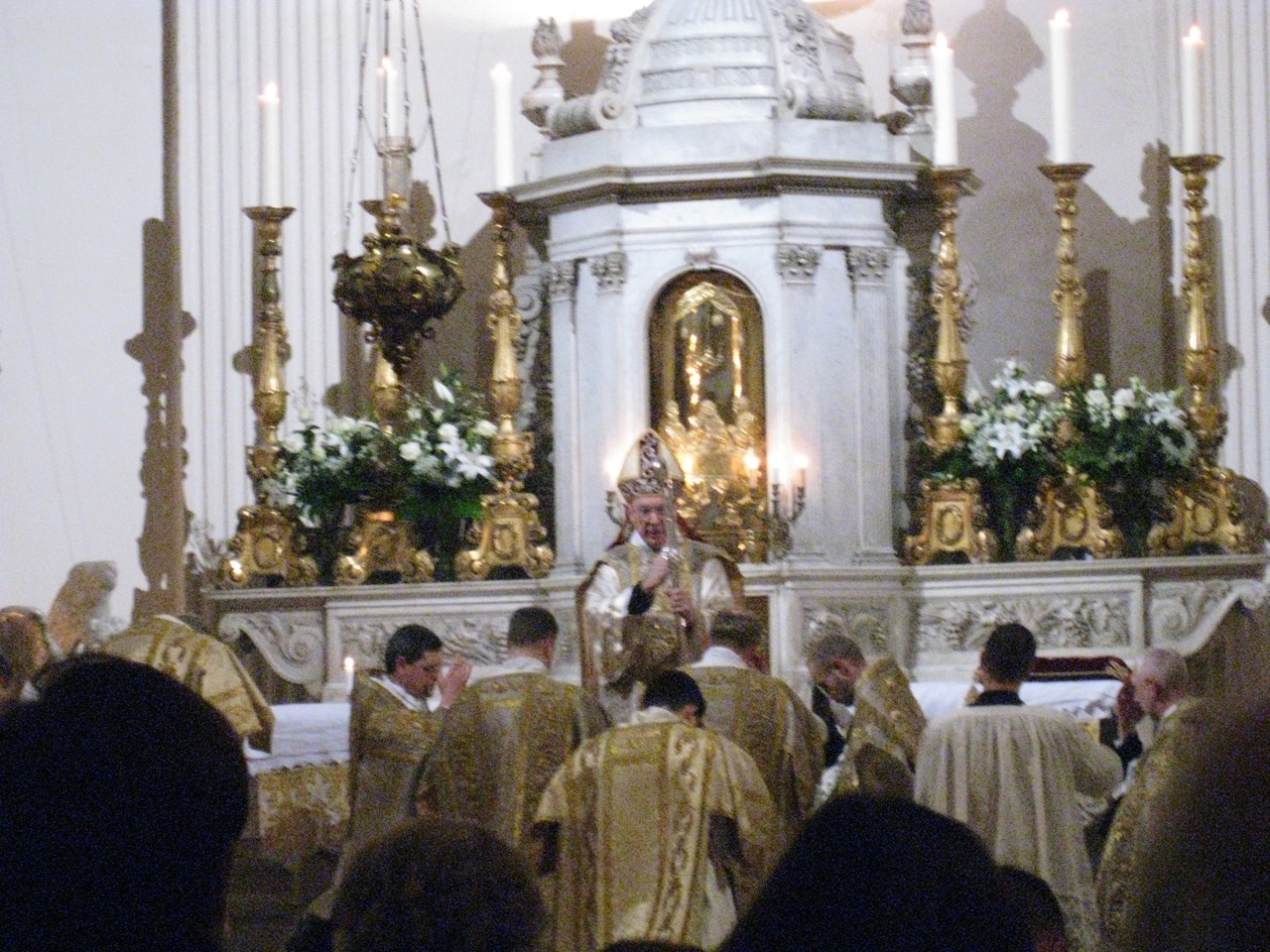
Yesterday at 18:30, Mgr. André Léonard, archbishop of Mechelin-Brussels and primate of Belgium, celebrated a pontifical high mass according to the Extraordinary Form. The two hour long sung mass was celebrated in the church of Sts. Jean et Étienne aux Minimes, a church with quite a history, no doubt. Built in the early eighteenth-century in a style unique to the transition between the Baroque and the Classical, the Church found itself, first in the hands of St. Francis de Paola’s Order of Minims, (OM’s), then in the hands of the French Revolutionaries as a Temple of Reason, and now in the hands of the Priestly Fraternity of St. Peter (FSSP). From now on, the FSSP-Beglium will say masses in the extraordinary form at this church every Fri., Sat., and Sun.
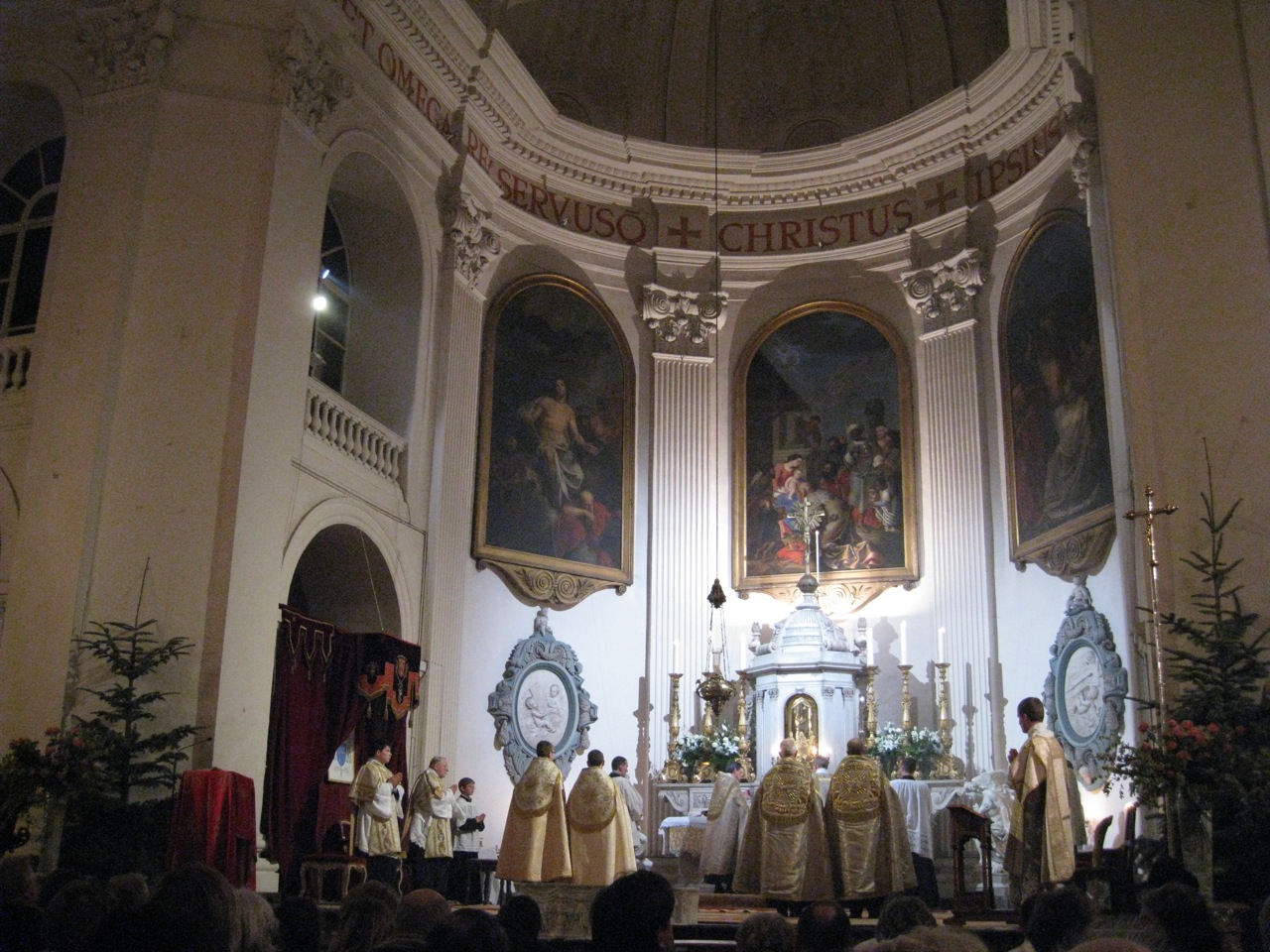
Given that the pontifical rite in the Extraordinary Form is perhaps one of the most complex liturgies to carry out, the FSSP should be commended for the mass’s solid execution, along with the cantors and one of the oldest organs in Belgium. Without knowing any definite numbers, it must also be said that the mass was very well attended. Not only was the church full, but the diversity of age was striking; notable was the amount of young families and teenagers.
SOURCE
Experiencing the Extraordinary Mass!

The Ecclesia Dei Society of Saint Joseph in partnership with Fr. Jojo Zerrudo of the Parish of Our Lord of the Divine Mercy of the Diocese of Cubao, offers the Extraordinary Form of the Mass with Missa Cantata (Sung Mass) every Sunday @1:30 pm at Parish of Our Lord of the Divine Mercy, Sikatuna Village, Quezon City.
Come and experience the Mass of all ages!
photo courtesy of Mr. Maturan of the Ecclesia Dei Society of Saint Joseph
DIFFUSION OF THE GREGORIAN MASS


This afternoon, after holy Mass, I had the pleasure of meeting the new pastor at St. John the Baptist Catholic Church in Chico. Fr. Timothy Nondorf replaces Fr. Blaise Berg as both pastor of St. John’s and chaplain of the Newman Center. Fr. Nondorf told us that he is in the process of learning the Extraordinary Form, which is of course a great relief to our little community. Chico is home to the only approved Latin Mass in the diocese north of Sacramento, and it seems that our bishop is committed to keeping it here.
We welcome Fr. Nondorf to Chico and are looking forward to getting to know him over the coming months and years. At the same time we will greatly miss Fr. Berg, who was so generous with his time and talent, and who often went “the extra mile” for the Latin Mass community here. Fr. Berg is now the Vicar of Clergy for the Diocese of Sacramento.
By the way, St. John’s is blessed with two additional priests who celebrate the traditional Mass, so we’re not expecting any interruptions.
Pictures from Solemn High Mass at the "Old Kenrick" Seminary


I have posted pictures from the Solemn High Mass held during a day-long workshop on the Extraordinary Form of the Holy Mass, which was celebrated in the "Old Kenrick" St. Vincent De Paul Chapel. Now the Cardinal Rigali Center (housing the Archdiocesan offices), the chapel used to serve the students and faculty of the Kenrick School of Theology, the Archdiocese's major seminary. The chapel is built using choir stalls, and is ornately decorated with wood carvings and beautiful stained glass. Click here to see all the pictures.
THE HOLY FATHER AND THE ORDINARY FORM OF THE MASS AS HE CELEBRATES IT
Cardinal Ratzinger celebrating the EF Solemn High Pontifical Mass:

An unknown pope prior to Vatican II celebrating Mass at the altar of the Basilica of St. John Lateran; It looks like Pope Benedict and there isn't much different about this photo and how the pope celebrated the Corpus Christi Mass yesterday if a picture was taken from this angle:

The Pope at the Basilica of Saint Paul Outside the Walls:

We know for a fact that as Cardinal Ratzinger, the Holy Father celebrated the Extraordinary Form of the Mass himself and defended the rights of traditional Catholics to have access to it. With these sensibilities, the Holy Father has broadened the permission of the celebration of this Mass and that has trickled down to good old Macon, Georgia and my parish. The Holy Father has real power!
However, as pope, Pope Benedict has not publicly celebrated the Extraordinary Form of the Mass. He did state that he hoped having its celebration more widely accepted would influence the way priest celebrate the normal or Ordinary Form of the Mass and that even the Ordinary normal form of the Mass might influence the EF in some ways--I think he meant verbal active and internal participation for both forms without the excesses of individualism or private piety and or personality of either form.
But with that said, as I watched the Holy Father celebrate the Corpus Christi Mass yesterday at his Cathedral Church, the Basilica of Saint John Lateran and more as the Bishop of Rome rather than the head of the universal Church, I detected what the Holy Father really wants for the Ordinary Form of the Mass which he is modeling, not imposing (yet anyway) and perhaps sees his successors implementing through legislation. In other words, he's paving the way for the reform of the reformed Mass but within continuity of the EF Mass. Of course I'm not clairvoyant, but as you know, maybe I am.
What did I see at yesterday's marvelous celebration of Corpus Christi at Saint John Lateran?
1. A Mass that most parishes and parish priests could celebrate with a schola and some well trained altar servers
2. A lovely well-choreographed procession and recession and liturgical ministers who were well trained and carried out their functions with style and dignity.
3. The official Introit Psalm with refrain chanted in Latin and in Gregorian Chant--no metrical hymn chosen as an option.
4. The Sign of the Cross, Greeting, brief introductory remarks preparing for the penitential act (Confiteor) and "absolution" said/sung in the vernacular (Italian). The Kyrie in Greek and the Gloria in plain chant Latin with the Collect sung in Italian.
5. A marevelous Liturgy of the word as is done in most parishes with lay lectors.
6. A deacon chanting the Gospel in the vernacular (Italian in this case).
7. A wonderful homily
8. The Credo sung in a plain chant Latin format
9. The General Intercession chanted in Italian.
10. The presentation of the Gifts as in most parishes
11. The simple preparation of the altar and preparation of the gifts with incense and the schola singing the offertory Latin Gregorian Chant.
12. The Prayer over the Offerings in Italian and chanted
13. The preface dialogue,preface and Eucharistic Prayer II chanted in Latin.
14. The Pater Noster chanted in Latin but with the Italian embolism and doxology.
15. The Sign of Peace offered to one another as in most parishes but in a sober way
16. The Agnus Dei in Latin, but the Ecce Agnus Dei in Italian
17. The official Communion antiphon and psalm in Latin Gregorian Chant
18. Holy Communion to communicants kneeling and receiving on the tongue, not in the hand
19. The Prayer after Holy Communion in Italian and if there had been a solemn blessing and dismissal in Italian; these were omitted because of the subsequent liturgical Eucharistic Corpus Christi Procession.
20. The altar was decorated as in for the EF Mass but what is now called the Benedictine arrangement for the OF Mass. At St. John Lateran as with St. Peter's Basilica and the other major basilicas of Rome, the altar faces east and the direction of the celebrant has never changed from the EF to the OF--so there was built in continuity in all the Roman Basilicas.
This form of the Mass could be celebrated in any parish with some Latin or simply English chants.

An unknown pope prior to Vatican II celebrating Mass at the altar of the Basilica of St. John Lateran; It looks like Pope Benedict and there isn't much different about this photo and how the pope celebrated the Corpus Christi Mass yesterday if a picture was taken from this angle:

The Pope at the Basilica of Saint Paul Outside the Walls:

We know for a fact that as Cardinal Ratzinger, the Holy Father celebrated the Extraordinary Form of the Mass himself and defended the rights of traditional Catholics to have access to it. With these sensibilities, the Holy Father has broadened the permission of the celebration of this Mass and that has trickled down to good old Macon, Georgia and my parish. The Holy Father has real power!
However, as pope, Pope Benedict has not publicly celebrated the Extraordinary Form of the Mass. He did state that he hoped having its celebration more widely accepted would influence the way priest celebrate the normal or Ordinary Form of the Mass and that even the Ordinary normal form of the Mass might influence the EF in some ways--I think he meant verbal active and internal participation for both forms without the excesses of individualism or private piety and or personality of either form.
But with that said, as I watched the Holy Father celebrate the Corpus Christi Mass yesterday at his Cathedral Church, the Basilica of Saint John Lateran and more as the Bishop of Rome rather than the head of the universal Church, I detected what the Holy Father really wants for the Ordinary Form of the Mass which he is modeling, not imposing (yet anyway) and perhaps sees his successors implementing through legislation. In other words, he's paving the way for the reform of the reformed Mass but within continuity of the EF Mass. Of course I'm not clairvoyant, but as you know, maybe I am.
What did I see at yesterday's marvelous celebration of Corpus Christi at Saint John Lateran?
1. A Mass that most parishes and parish priests could celebrate with a schola and some well trained altar servers
2. A lovely well-choreographed procession and recession and liturgical ministers who were well trained and carried out their functions with style and dignity.
3. The official Introit Psalm with refrain chanted in Latin and in Gregorian Chant--no metrical hymn chosen as an option.
4. The Sign of the Cross, Greeting, brief introductory remarks preparing for the penitential act (Confiteor) and "absolution" said/sung in the vernacular (Italian). The Kyrie in Greek and the Gloria in plain chant Latin with the Collect sung in Italian.
5. A marevelous Liturgy of the word as is done in most parishes with lay lectors.
6. A deacon chanting the Gospel in the vernacular (Italian in this case).
7. A wonderful homily
8. The Credo sung in a plain chant Latin format
9. The General Intercession chanted in Italian.
10. The presentation of the Gifts as in most parishes
11. The simple preparation of the altar and preparation of the gifts with incense and the schola singing the offertory Latin Gregorian Chant.
12. The Prayer over the Offerings in Italian and chanted
13. The preface dialogue,preface and Eucharistic Prayer II chanted in Latin.
14. The Pater Noster chanted in Latin but with the Italian embolism and doxology.
15. The Sign of Peace offered to one another as in most parishes but in a sober way
16. The Agnus Dei in Latin, but the Ecce Agnus Dei in Italian
17. The official Communion antiphon and psalm in Latin Gregorian Chant
18. Holy Communion to communicants kneeling and receiving on the tongue, not in the hand
19. The Prayer after Holy Communion in Italian and if there had been a solemn blessing and dismissal in Italian; these were omitted because of the subsequent liturgical Eucharistic Corpus Christi Procession.
20. The altar was decorated as in for the EF Mass but what is now called the Benedictine arrangement for the OF Mass. At St. John Lateran as with St. Peter's Basilica and the other major basilicas of Rome, the altar faces east and the direction of the celebrant has never changed from the EF to the OF--so there was built in continuity in all the Roman Basilicas.
This form of the Mass could be celebrated in any parish with some Latin or simply English chants.
Mass in the Extraordinary Form at St Charles
Blogged by James Preece 1 Year ago...
On Tuesday evening I took Leona (aged 3) along to a Mass in the Extraordinary Form at St Charles in Hull. In the language of the Latin Mass people this was "a Solemn Mass in the usus antiquior" but I have no idea what a solemn Mass in the usus antiquior that is not solemn would look like. Presumably there are more drums? I am being silly of course.
We arrived late which actually mean't we arrived early - we thought the Mass began half an hour earlier than it did and then got stuck in loads of traffic and the queue for some roadworks and a football match. I whispered to Leona that it was very important to enter quietly as we walked in to an empty Church in which nobody had yet arrived.

I couldn't make Leona sit in silence for half an hour waiting or Mass to start and then expect her to behave during Mass itself so I took the opportunity to show her around the Church, we looked at several statues of Mary, identified the baby Jesus and tried to explain about angels. We approached the statue of St Peter where Leona asked "What is he holding?" "What do you think he is holding?" "Keys" and we kissed his foot before moving on to another icon of Mary and then St Francis. As we worked back around the Church we lit a candle and Leona asked if she could kiss St Peter's foot again.
Mass began and was beautiful and suprisingly easy to follow in most places, this is only my third Mass in the extraordinary form and I had little trouble recognising words and phrases like "sanctus", "agnus dei", "pater noster" and "oremus". There is suprisingly little Latin you actually need to know to get by.

Leona was very well behaved despite her tiredness largely I think due to the palpable sense of there being something very special going on. She did ask what that man was doing? "With the gold thing on the chain?" I asked? "Yes", "That is insense", "What's insense?", "Well the smoke of insense represents our prayers going up to heaven?", "What he doing now?", "He's insensing the altar?", "What he doing now?", "He's insensing the servers?", "What he doing now?", "He's insensing you..." Cue huge smile on Leona's face. "I like insense".
She was very excited to go up at the end and venerate the relic of the true cross. I was a bit nervous that Fr Cahil might pass over her (she's only little) but she was soon in there with the kiss and more beaming smiles. I've never seen her that happy about anything in the Ordinary Form.

The even was a little tinged with sadness because it is the last time we will see our friend Richard in Hull (on left above) before he moves to Leicestershire to join the dominicans. Richard has done a lot for the promotion of non-pappy religion in Hull so thankyou Richard. We'll miss him.
Taking photos in dark rooms with four year old camera from before the days of proper noise reduction - especially when there's a toddler on your other arm but I think I did okay, more photos here.
source
We arrived late which actually mean't we arrived early - we thought the Mass began half an hour earlier than it did and then got stuck in loads of traffic and the queue for some roadworks and a football match. I whispered to Leona that it was very important to enter quietly as we walked in to an empty Church in which nobody had yet arrived.
I couldn't make Leona sit in silence for half an hour waiting or Mass to start and then expect her to behave during Mass itself so I took the opportunity to show her around the Church, we looked at several statues of Mary, identified the baby Jesus and tried to explain about angels. We approached the statue of St Peter where Leona asked "What is he holding?" "What do you think he is holding?" "Keys" and we kissed his foot before moving on to another icon of Mary and then St Francis. As we worked back around the Church we lit a candle and Leona asked if she could kiss St Peter's foot again.
Mass began and was beautiful and suprisingly easy to follow in most places, this is only my third Mass in the extraordinary form and I had little trouble recognising words and phrases like "sanctus", "agnus dei", "pater noster" and "oremus". There is suprisingly little Latin you actually need to know to get by.
Leona was very well behaved despite her tiredness largely I think due to the palpable sense of there being something very special going on. She did ask what that man was doing? "With the gold thing on the chain?" I asked? "Yes", "That is insense", "What's insense?", "Well the smoke of insense represents our prayers going up to heaven?", "What he doing now?", "He's insensing the altar?", "What he doing now?", "He's insensing the servers?", "What he doing now?", "He's insensing you..." Cue huge smile on Leona's face. "I like insense".
She was very excited to go up at the end and venerate the relic of the true cross. I was a bit nervous that Fr Cahil might pass over her (she's only little) but she was soon in there with the kiss and more beaming smiles. I've never seen her that happy about anything in the Ordinary Form.
The even was a little tinged with sadness because it is the last time we will see our friend Richard in Hull (on left above) before he moves to Leicestershire to join the dominicans. Richard has done a lot for the promotion of non-pappy religion in Hull so thankyou Richard. We'll miss him.
Taking photos in dark rooms with four year old camera from before the days of proper noise reduction - especially when there's a toddler on your other arm but I think I did okay, more photos here.
source
The Holy Sacrifice of the Mass - An Explanation
Father Christopher Smith (Chant Cafe) has completed a series of posts on the Mass, which I am happy to post here, in order, and in their entirety. Enjoy!


Explanation of the Ceremonies of Holy Mass, Part I: Before Holy Mass
Sunday is the LORD’s Day. Christians rise with the sun on the eighth day, the first new day of a new age of the Resurrection, and go to buildings which have been set apart for divine worship by the name church. They are called church because it is the Mystical Body of Christ, the Church, which assembles there in the presence of God just as the twelve tribes of Israel assembled at the foot of Mt Sinai to receive the Law and came to the temple in Jerusalem to offer sacrifices to ask God to forgive their sins. Christians come to celebrate the sacrament of the Eucharist, a word which means thanksgiving


![[ef,cardinale1.jpg]](https://blogger.googleusercontent.com/img/b/R29vZ2xl/AVvXsEgVKakp45AaZ9uD8saVnfSjRosIijceyXAq1N9j12poim6izfO6t0AOALopuNYsdg3XTfNojwjx8f10tqAwb1wtALGkAkp5qQ9K5KIX5nO9MFkevd4VW3RfbBdrKhpwH0cAlb2k4KOevGQ/s400/ef,cardinale1.jpg)


